
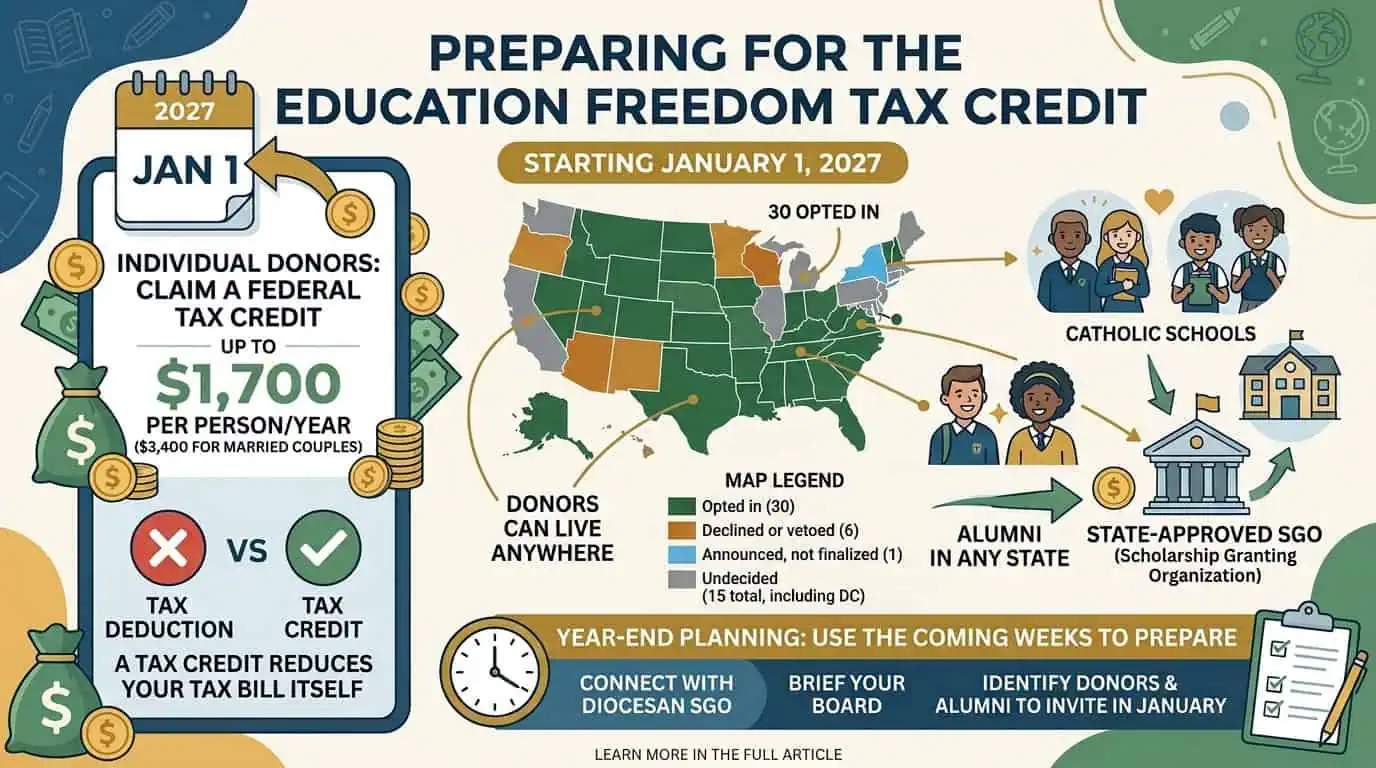
The federal scholarship tax credit begins January 1, 2027, creating a new opportunity to support Catholic school scholarships. Individual donors may qualify for a credit of up to $1,700 annually for eligible cash gifts to a scholarship granting organization (SGO) in a participating state.
For Catholic school leaders, the work begins now. Gifts made in 2026 do not qualify for this credit, so your year-end appeal should continue supporting the annual fund. Meanwhile, prepare your community, connect with an SGO, and help donors understand the scholarship opportunity ahead.
This guide explains how the credit works, what schools can do before January, and how alumni living in other states may participate.
What is the Education Freedom Tax Credit?
The EFTC, created in the 2025 federal budget law and codified as Section 25F of the tax code, is a credit, not a deduction. A deduction lowers the income you are taxed on. A credit lowers the tax itself, so a $1,700 gift can reduce a donor’s federal tax bill by $1,700. The USCCB’s EFTC FAQ describes it as a one-to-one credit, and the IRS confirms the $1,700 limit and the January 1, 2027 start.
A few rules shape how we talk about it. Gifts must be cash, not stock. A donor cannot claim the credit and also deduct the same gift as a charitable contribution. You can carry forward unused credit for up to five years. According to the US Treasury, a joint return can claim up to $3,400, or $1,700 per spouse based on each spouse’s own gifts. The credit is nonrefundable, so it only offsets federal tax a donor actually owes. Donors should always consult their tax advisor.
The gift does not go to your school’s annual fund. It goes to an SGO, which awards scholarships to students from households at or below 300 percent of the area median income. Scholarships can cover tuition, fees, tutoring, books, uniforms, and other qualified expenses. This is not a voucher program, and no state education dollars are involved.
What should our school be doing before the year ends?
Start by protecting the cadence you already have. Your year-end appeal to the annual fund should go out as planned. The credit is an additional way for people to invest in Catholic education, and it should never become a reason a loyal annual fund donor gives less. Say so plainly in your messaging: a gift to the annual fund this December, and an opportunity to direct federal tax dollars to scholarships in the new year.
Next, find your SGO. A qualifying SGO must be a registered 501(c)(3) with state approval, serve at least ten students across at least two schools, and spend 90 percent of its receipts on scholarships. Because of that two-school threshold, a single school will generally partner with a diocesan or regional SGO rather than form its own. Call your diocesan office this month.
In Iowa, for example, the four dioceses created a shared SGO, and it already invites out-of-state donors. Know the limits up front. The Treasury and Education Department FAQ says donors may not earmark gifts for a particular student and that SGOs determine scholarship amounts, while the USCCB FAQ suggests school-specific designation may be possible. Ask your SGO what it permits, and do not promise donors that their gift will fund your school.
Then build understanding before you build a campaign. Brief your board, pastor, and advancement team. Prepare a one-page explainer you can hand to a donor. Look at your database and identify who might benefit: donors with meaningful federal tax liability, alumni, former parents, and grandparents. And start identifying families who may qualify for scholarships, because SGOs must verify household income and will give priority to prior recipients and their siblings.
Finally, put a short, accurate note in your year-end letter. Something like: “Beginning in January, you may be able to direct up to $1,700 of your federal taxes to scholarships for Catholic school students. Watch for details from us after the first of the year.” That keeps the relationship warm without promising a 2026 benefit.
Which states have opted in?
Participation is voluntary, and each state or the District of Columbia must elect to join and submit its list of approved SGOs to the IRS before donors there can give and claim the credit. As of October 1, 2026, the IRS lists these 30 states:
| Status | States |
|---|---|
|
Opted in (30) |
Alabama, Alaska, Arkansas, Colorado, Florida, Georgia, Idaho, Indiana, Iowa, Kansas, Kentucky, Louisiana, Mississippi, Missouri, Montana, Nebraska, Nevada, New Hampshire, North Carolina, North Dakota, Ohio, Oklahoma, South Carolina, South Dakota, Tennessee, Texas, Utah, Virginia, West Virginia, Wyoming |
| Declined of vetoed | Arizona, Hawaii, Minnesota, New Mexico, Oregon, Wisconsin |
| Announced, not finalized | New York |
| Undecided | California, Connecticut, Delaware, District of Columbia, Illinois, Maine, Maryland, Massachusetts, Michigan, New Jersey, Pennsylvania, Rhode Island, Vermont, Washington |
The counts have moved quickly: the IRS reported 27 states in June, and the list has grown since. Check the IRS page and the EFTC state tracker before you publish anything to donors. Under the Treasury and Education Department FAQ, states have until January 1, 2027, to elect in, and SGO lists are due February 15, 2027. Undecided states can still join, and early-2027 gifts may have to wait until your SGO appears on its state’s list.
Can alumni in states that did not opt in still take advantage?
Yes, and this is the part many schools might overlook. According to the USCCB FAQ, individuals anywhere in the country can donate and claim the credit, as long as the SGO operates in an opted-in state. Scholarships can benefit only students in opted-in states. Law firm guidance adds that SGOs operating in several states keep separate accounts for each, and donors can choose where their gift goes. Treasury’s October 1 announcement confirms donors may give regardless of their state of residence. Donors must be U.S. citizens or residents.
So an alumnus of your Ohio school who now lives in Pennsylvania cannot direct a scholarship to a Pennsylvania child, because Pennsylvania has not opted in. But that alumnus can give to your diocese’s SGO and claim the credit on a federal return. In effect, their federal tax dollars can support Catholic school scholarships in the state where they were formed.
The approach follows IPSD’s 7I’s. Identify alumni, former parents, and grandparents by mailing address, and flag those living outside opted-in states. Inform them with a short, clear explanation: your home state did not opt in, but your school’s state did, and you may still direct up to $1,700 of your federal taxes to Catholic school scholarships here. Invite personally. For your closest relationships, that means a phone call, video visit, or note from a classmate, principal, or pastor. A mass email can follow for everyone else, but belonging leads to believing, and the invitation lands best when it comes from someone they know. Involve them through class notes, alumni events, and stories of scholarship recipients. Then steward every gift as a way of life with a prompt thank-you and a report on the students served.
A mission-first close
The credit is a new roadway, and like every roadway in development, it works only when people travel it by invitation. Behind every scholarship is a family choosing Catholic education, and behind every credit gift is a donor who believes in it. This year, use the weeks before January to get ready. If your community would like help building the plan, the ISPD team is glad to walk through it with you.
Dr. Mark Williams is an ISPD Associate and the State Director of Aspiring Scholars, a Louisiana-based scholarship-granting organization.