
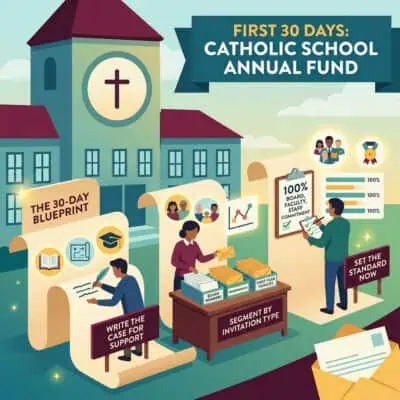
Here’s the mistake most schools make: they treat the Annual Fund as “starting” the day the first letter goes out.
By then, it’s already too late.
The real work happens in the 30 days before a single pledge card is mailed. That window quietly sets:
- Your case for support — why should people invest?
- Your organizational structure — who is inviting whom?
- Your leadership standard — what does participation look like for boards, faculty, and staff?
- Your communication plan — are you educating people, or just asking them?
Get the first 30 days right, and your Annual Fund runs the rest of the year with purpose and peace. Get them wrong, and you’ll spend the other eleven months explaining what you meant to do.
Here’s the ISPD roadmap for those first 30 days.
1. Start with the Case, Not the Letter
Before you write a single appeal letter or design a brochure, write your Annual Fund Case for Support. This becomes the source document for every letter, email, reception, and pulpit talk that follows.
In 1–2 pages, clearly articulate:
- Mission — one strong paragraph on who you are and why you exist.
- Brief profile — a short snapshot of your school today: enrollment, grades, Catholic identity.
- Unique strengths — 5–10 “wow” or distinctive qualities.
- Recent successes — concrete signs of life: student achievement, faith formation, service, facilities.
- Future vision — where you’re headed over the next 3–5 years.
- This year’s specific case points — where, exactly, will Annual Fund dollars go this year? Faculty and staff professional growth, tuition assistance, technology, small capital projects, mission and Catholic identity initiatives — name it.
Then put the case to work:
- Pull language from it into every division letter — Major Gifts, Leadership, Parents, Alumni, Friends, Business, Parish.
- Train your Annual Fund leaders to speak these same points in their own words.
- Keep the fund flexible in print — emphasize priorities rather than publishing a restrictive line-item list.
Skip this step, and you end up persuading with adjectives instead of inviting people into a clear plan.
2. Segment by Relationship and Invitation, Not Just by Dollars
People aren’t just “donor levels” — they’re publics and divisions, each with a different relationship to the school:
- Major Gift Division
- Leadership Gift Division (board, faculty, staff)
- Parent Gift Division
- Alumni Division
- Friends / Past Parents / Grandparents Division
- Parishioner Division (where applicable)
- Business Community Division
- Student Division
The first 30 days should clarify three things:
- Which divisions you’ll realistically launch this year. If you’re just launching an Annual Fund, don’t try to tackle every division. For example, if you work for a Catholic elementary school, focus on parents, parishioners, and major donors.
- Who fits where — not just by giving capacity, but by relationship and role.
- How each division will be invited: eyeball-to-eyeball, small group, phone, or mail/email.
A few examples of what that looks like in practice:
- A board member is invited to leadership: 100% participation and a stretch gift as a visible sign of commitment.
- A first-year family is invited to belonging: prayer, participation, and a first financial gift at a level that feels attainable.
- A grandparent is invited to legacy: partnering with you to sustain a school they love for their grandchildren and the students who follow.
Write to the relationship first. The financial ask flows naturally from there — not from a generic appeal.
3. Set the Leadership Standard: 100% Participation, Early
The Annual Fund is about people before it’s about money. That becomes visible the moment your internal leaders go first.
In the first 30 days, quietly and personally invite 100% participation from:
- Board and council members
- Faculty and staff
- Key committee and Core Team members
The goal isn’t a specific dollar figure from every leader. The goal is a clear signal to the wider community: those closest to the mission have already invested — in prayer, in service, and in a financial gift according to their means. It’s a culture that says, “We don’t ask others to do what we ourselves aren’t willing to do.”
Set this standard in September, before the broader community appeal, and it reads as leadership. Wait until March, and the same ask can feel like pressure — or crisis.
4. Build a Simple 30-Day Calendar — Not Just a Mail Date
Use the first month to build structure around the whole year. A sample calendar might look like this:
Week 1
- Finalize your case for support and the 3–5 main case points for this year.
- Confirm Annual Fund Chairs and Associate Chairs.
- Map which divisions you’ll activate this year — start small if you need to.
Week 2
- Identify and confirm Major Gift Division prospects — start your “list of 50–100.”
- Confirm your Leadership Division list: board, faculty, staff, key leaders.
- Schedule your first Annual Fund Cabinet / Core Team meeting.
Week 3
- Draft division-specific letters and materials, all drawn from the main case.
- Begin quiet, personal outreach to board and faculty/staff for their three gifts.
- Introduce the Annual Fund theme and case points internally — meetings, email, faculty gathering, board meeting.
Week 4
- Finalize your timeline for Major Gifts, Leadership, Parents, Alumni, and Friends, using a July–June mindset.
- Schedule Major Gift visits and, if appropriate, a small Major Gift reception.
- Prepare your first outward-facing communication — a save-the-date email, a short newsletter article, a parish bulletin note — that educates before it invites.
None of this needs to be elaborate. It does need to be written down, shared with leadership, and followed.
5. Educate Before You Invite
Before the ask goes out, make sure your core audiences understand:
- That tuition does not cover the full cost of a Catholic education at your school.
- That you intentionally keep tuition below full cost so more families can afford that education.
- That the Annual Fund bridges that gap and advances mission-critical priorities.
- That you’re inviting three gifts, not one: prayer, service and participation, and financial support.
Put this message everywhere the community already gathers:
- Faculty meetings
- Board and council meetings
- Parent orientation or back-to-school nights
- Parish bulletin inserts or a short pulpit announcement, where applicable
- One clear “What Is Our Annual Fund?” Q&A piece people can read or share
When people are educated first, the invitation that follows feels like the next natural step in a shared mission — not a surprise bill.
6. Remember: The First 30 Days Are Foundation, Not Finish
In the ISPD cadence, a strong Annual Fund is built over 2–4 years, not 30 days. What the first month actually does is:
- Clarify your case and purpose
- Confirm your leadership and structure
- Set expectations for participation
- Lay out the calendar
Spend the first month solely on getting a letter out the door, and you’ll collect some quick dollars — but miss the deeper work: real involvement of your people in the mission and vision ahead.
Spend it building this foundation instead, and every letter, call, reception, and phonathon that follows for the rest of the year will carry clarity, credibility, and grace.