
The short answer: Catholic parishes can seek input from parishioners in three proven ways: a one-page parish survey, 50-minute input sessions with 10 to 15 randomly invited parishioners, and the Ultimate Question (a Net Promoter Score). Each should be done at least once a year, and the results should always be shared back with the community.
St. John Paul II spoke of the “ancient pastoral wisdom” that encouraged pastors to listen more widely to the entire People of God. It’s a good reminder that listening isn’t a modern management technique. It’s pastoral work.
In Total Parish Development (Twenty-Third Publications, 2019), Lesson Nine makes this very practical. A vibrant development effort tests the pulse of the parish at least once a year. Doing that well isn’t complicated, but it does require intention. Here are three approaches ISPD has seen work across many parishes.
What is a parish survey?
A short written survey, designed with your core team around the areas where you most need feedback, tells you what parishioners are feeling about liturgy, communication, spiritual growth, youth involvement, hospitality, and facilities. Keep it to one sheet, front and back.
Offer it in the pew at every weekend Mass and online, so you reach both the people who are always there and those who prefer a link. Participation in the pew is high when the celebrant or a core team member introduces the survey and reads it aloud. People tend to fill it in as they listen.
What is a parish input session?
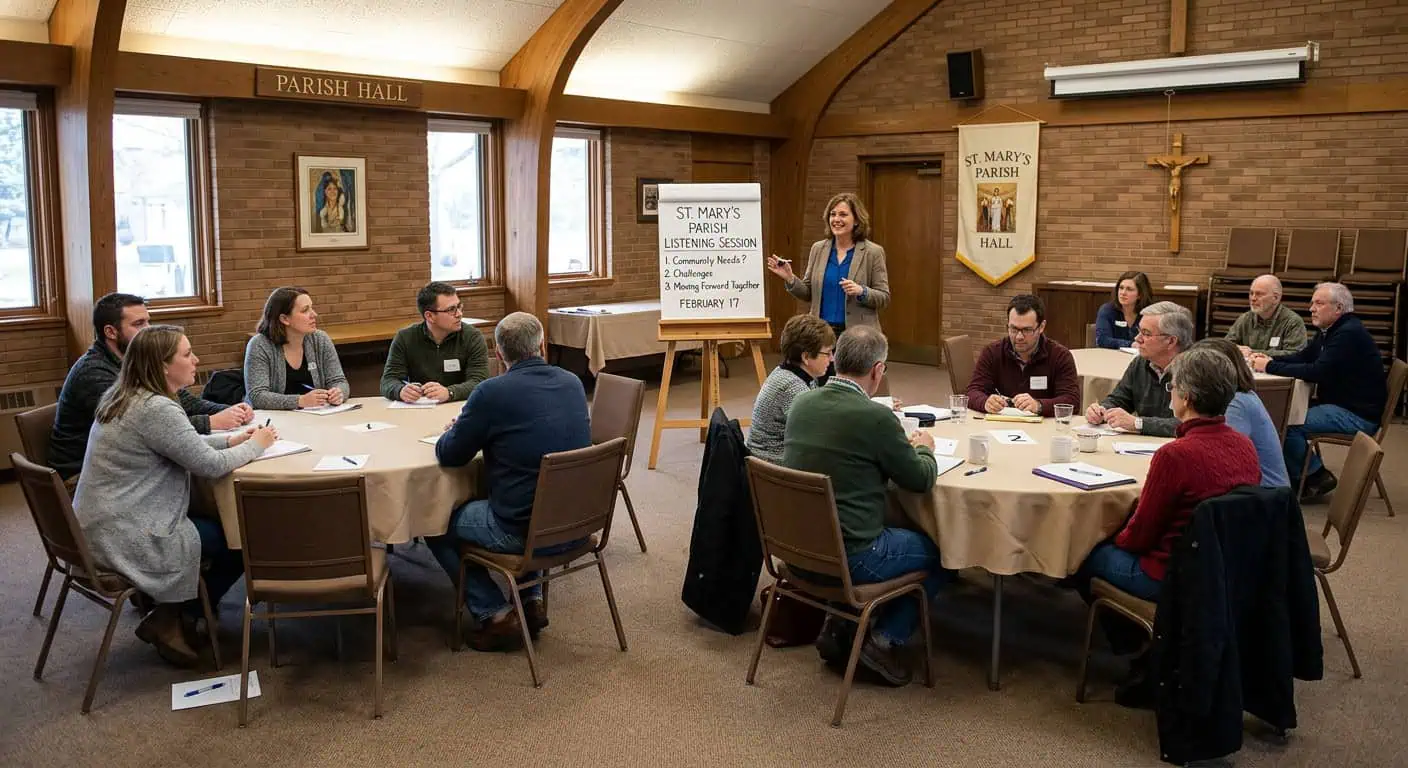
This is where listening becomes relationship. An input session is a 50-minute gathering of 10 to 15 randomly selected parishioners, built around three questions:
- What is working well in our parish?
- What are the greatest needs?
- Looking ahead, what would you like to see here?
How to run input sessions
- Randomly select parishioners from your parish list.
- The pastor signs a personal, mailed invitation.
- A core team member follows up by phone within a week, offering a choice of times.
- A core team member facilitates the session while a scribe takes notes.
- Within a few weeks, everyone who attended receives a short written summary and a thank-you.
The details are what make it work. People know it’s one hour, with a clear agenda, and not a standing committee.
An unexpected benefit: input sessions are one of the best ways to identify the future leaders of your parish. Many of the people you invite will be second- and third-ripple parishioners you’ve never met, so don’t be discouraged if attendance varies. Relationships take time.
What is the Ultimate Question, and what is a good Net Promoter Score for a parish?
Based on Fred Reichheld’s work, this survey asks one question: How likely are you to recommend our parish to a friend, neighbor, or family member? Scores of 9–10 are Promoters, 7–8 are Passives, and 0–6 are Detractors. Your Net Promoter Score is the percentage of Promoters minus the percentage of Detractors.
| Net Promoter Score | ISPD Rating |
|---|---|
| Above 65% | Outstanding |
| 50%-64% | Average |
| 35%-49% | Below Average |
| Below 34% | Dismal |
A follow-up prompt, asking what would earn a 10, gives you honest, usable comments. Ask it at least once a year. It’s easy to send by email.
Why seeking parishioner input matters
All three methods serve the same purpose. Seeking input is the Invite step of the 7 I’s, one of the roadways, avenues, and vehicles through which people come to belong. And belonging leads to believing. When people are asked their opinion, and then see that it was heard and acted on, they begin to see the parish as theirs.
One caution from the lesson: closing the loop is everything. Share what you heard, thank people, and show what will change. Input without follow-through teaches people that asking was a formality.
Where to start
Ask which groups you’ve heard from in the past 12 months: staff, parish council, finance council, ministry leaders, school staff, parishioners, neighbors. Then choose the group you’ve heard from least and invite their input in the next six months.