Sometimes a school does not need a five-year plan for the whole institution. It needs enrollment to stop slipping, and it needs to know where in the funnel it is losing families.
This is the process for that. Six to eight months, focused entirely on enrollment management, delivered either to a single school or to a group of schools together in partnership with a diocesan Office of Catholic Schools.
Enrollment management is not admissions. Admissions is an office. Enrollment management is a discipline the whole school carries — because the family who re-enrolls without hesitating and the family who tells a neighbor about you are usually the same family, and neither one was recruited by a brochure.
months, start to finished plan
ranked Challenges drive the whole plan
months of dated calendar, June through May
one school, or a diocesan cohort together
You leave with next year already scheduled
Most consulting engagements end with a plan. This one ends with a plan and a calendar — twelve months, June through May, with dated commitments in every one of them.
June: review last year’s funnel grade by grade and name what you lost. July: finalize the prospective-family pipeline, segments, and touchpoints. August: launch new-family onboarding. September: thirty-day check-ins with every new family, and the first faculty retention read. October: the archdiocesan admissions process opens; open houses and campus visits begin. November: feeder-school and parish visits. December: re-enrollment portals finalized. January: the re-enrollment campaign, with real incentives and a personal conversation for every family flagged at risk. March: shadow days, spring visits, and thank-yous. May: evaluate, report a year in review, and set next year’s calendar.
That last line is the point. The calendar is built to be rewritten every May, which is how a plan becomes a practice instead of a document.
How the Process Runs

The Enrollment Funnel Review
Most schools can tell you how many students they lost. Very few can tell you where.
So we map it. Every point at which a family enters, decides, or leaves, tracked as a system rather than as a season:
Inquiry to visit. How many families ask, and how many actually come.
Visit to application. What the campus experience does to the decision.
Application to enrollment. Where the yield goes and why.
Year to year re-enrollment, by grade — because attrition concentrates.
The transition grades. Fifth to sixth. Eighth to ninth. Where schools quietly lose the students they already have.
Each stage gets an owner, a number, and a review date — and the findings go to your principal and Executive Committee before next year’s admissions calendar is approved, not after.
It moves enrollment from a marketing push in January to a discipline the whole school carries all year. Which is the point: enrollment management is ministry, not marketing.
Two ways to engage
A single school. Your own Executive Committee, your own assessment, your own plan and calendar.
A diocesan cohort. ISPD partners with an Office of Catholic Schools to bring a group of schools through together — shared workshops on Catholic school development, monthly coaching for every participating school, and a separate written plan and calendar for each one.
The cohort model does something a single engagement cannot. Principals and advancement directors who are usually working alone discover they are solving identical problems, and the peer relationships often outlast the engagement. For a diocese, it also means every school moves forward at once rather than one at a time.
If you lead an Office of Catholic Schools, start here.
This is the right process when
Consider another process if…
The whole school needs direction, not one function. That is a Strategic Growth Plan, and advancement becomes one Planning Area within it.
Fundraising is the pressing problem, not enrollment. That is the Strategic Plan for Advancement & Development.
You have the plan and need the person coached. Our enrollment management coaching works month to month with the people doing the job.
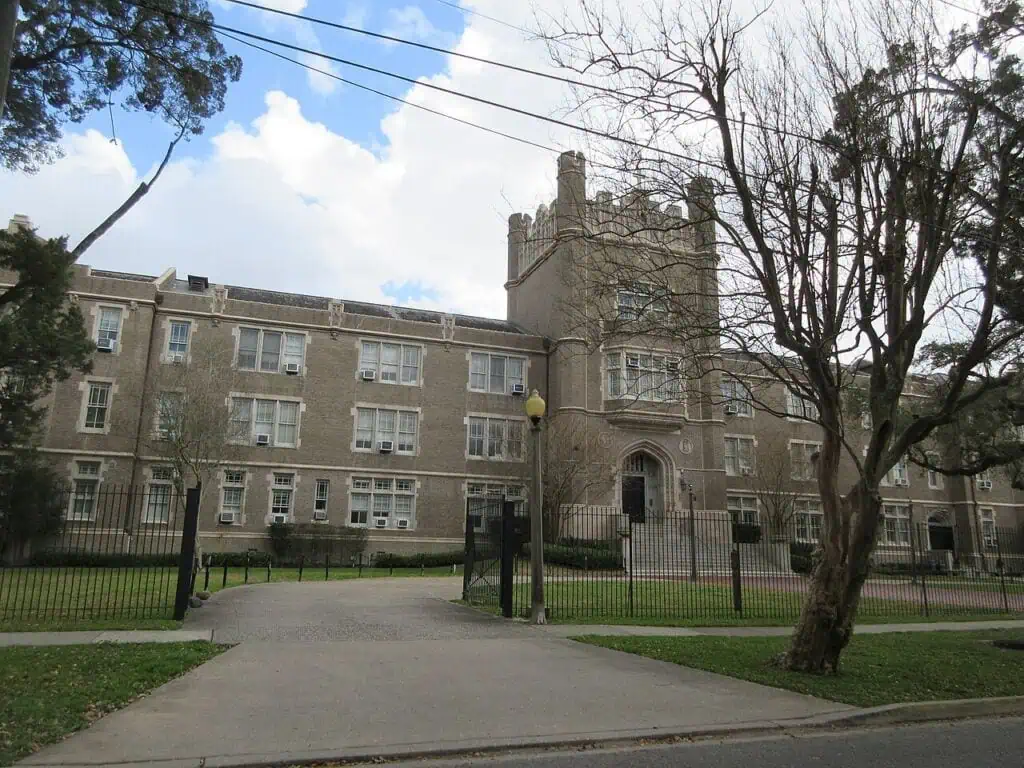
By Infrogmation of New Orleans - Own work, CC BY-SA 4.0
Success Story — New Orleans, Louisiana
Ursuline Academy
Ursuline Academy in New Orleans is the oldest Catholic school for girls in the United States, founded in 1727. A school with that much history does not have a brand problem. It had a different one: the students inside the building were not the ones telling the story.
ISPD began working with Ursuline in January 2023. An initial assessment, an Ultimate Question Survey of the whole school community, an Executive Committee, a newly formed Enrollment Management Core Team, two strategic planning workshops, and a Top 10 Selling Points exercise run separately with faculty and staff, with student leaders, and with the board. The Enrollment Management Strategic Plan of Action was delivered in July 2023. Frank Donaldson led the engagement.
Eight challenges emerged, ranked by the planning teams, by a multi-vote, and by individual ballots. The first priority was not recruitment. It was student pride. The second was retaining sixth and seventh graders.
That is the whole thesis of enrollment management in two lines. Before students can promote a school, they have to feel something about it — belonging leads to believing — and before a school chases new families, it should stop losing the ones already enrolled. The plan’s sharpest instruction reads: “actively recruit our own fifth and sixth graders like external prospects.”
From there the plan built outward: a big sister program keyed to each grade’s mascot, quarterly cross-division events, a visitation program that sends Ursuline students onto feeder-school campuses rather than waiting for feeder schools to visit, and the Lionheart program — a legacy pipeline that begins when an alumna has a baby, with the same current student sending a gift each year until the child is old enough to be invited to campus.
It also asked faculty to carry retention directly, through a monthly scorecard rating each student on six things — whether she builds friendships easily, participates, seems happy, enjoys lunch with others, is respected, and is never alone. Catholic schools usually learn a student is leaving in April. Teachers know in October.
Questions school leaders ask us
Admissions is an office. Enrollment management is a discipline.
Admissions handles inquiries, tours, applications, and acceptances. It is necessary, it is usually one or two people, and it ends when a family says yes.
Enrollment management covers the whole relationship: how a family first hears about you, what happens on the visit, what the first ninety days feel like, whether they re-enroll in April without thinking twice, and whether they tell someone else. It belongs to the faculty and the front office as much as to admissions.
Both fill seats. Only one of them keeps them filled.
Frequently they belong together — and the two processes share a foundation. Clean constituent data, a compelling story about the school, and families who feel they belong serve both. The family who re-enrolls without hesitating is often the same family who gives to the annual fund and tells a neighbor about you.
They remain separate engagements with separate plans, because they answer to different people and run on different calendars. If enrollment is the urgent problem, start here. If the annual fund and alumni are the urgent problem, start with the Strategic Plan for Advancement & Development.
Culture is most of it. That is exactly why retention cannot live in the admissions office.
A family does not decide to leave in April. They decide over months, and the signals show up in a classroom long before they show up on a re-enrollment portal — a child who has stopped being invited to things, a parent whose emails have gone quiet, a sibling who never applied.
So we put retention where the information already is. One school we worked with asks every faculty member for a monthly read on each student: does she build friendships easily, participate in class, seem happy most days, enjoy lunch with others, get respected by others, and is she ever alone. Six questions, once a month. Catholic schools usually learn a family is leaving in April. Teachers know in October.
Common, yes. Normal, no — and it is the most expensive attrition there is, because you already paid to recruit those families.
Fifth to sixth and eighth to ninth are the points where schools quietly hand students off to someone else, usually because nobody ever sold the next division to the families already inside the building. The fix is unglamorous, and it works: treat your own fifth and sixth graders like external prospects. Introduce them to the middle school faculty. Give them traditions to look forward to. Pair them with older students. Put the same effort into your family as you would into a family touring for the first time.
At one school we worked with, retaining sixth- and seventh-graders was the second-highest priority in the entire plan — ahead of every recruitment strategy on the list.
We map the funnel and put a number on every stage: inquiry to visit, visit to application, application to enrollment, and re-enrollment year over year, by grade.
Most schools can tell you the total. Very few can tell you the stage. Those are different problems with different answers — a school losing families between inquiry and visit has a follow-up problem, a school losing them between visit and application has a campus experience problem, and a school losing them in June has a retention problem it should have caught in October.
If your data is incomplete, that is normal and it is usually one of the first Challenges the plan names. We start with what exists, name a person responsible for its integrity, and build from there.
No, and the distinction matters more in Catholic schools than almost anywhere.
Marketing gets a family to look. Everything after that — whether the phone gets answered well, what the tour feels like, whether anyone follows up, what the first ninety days do to a new family, whether a teacher notices a child drifting — is enrollment management, and none of it is a campaign.
According to NCEA, the single biggest factor in a family’s choice of a Catholic school is how many times they have been on campus. You cannot buy that. You can only build the reasons to come and then be worth the visit. A larger advertising budget for a school that does not retain families is money spent filling a bucket with a hole in it.
Six to eight months from the first assessment to a written plan and calendar in hand.
Timing matters more here than in most engagements because enrollment runs on a fixed calendar. Most schools begin in the fall so the plan lands in spring, the new calendar starts in June with a full funnel review, and the first campaign it governs is the following year’s admissions season rather than one already underway.
Let’s Make Things Happen!
Tell us where your enrollment stands this year, and we will tell you where in the funnel to look first.
Contact us today to learn more.