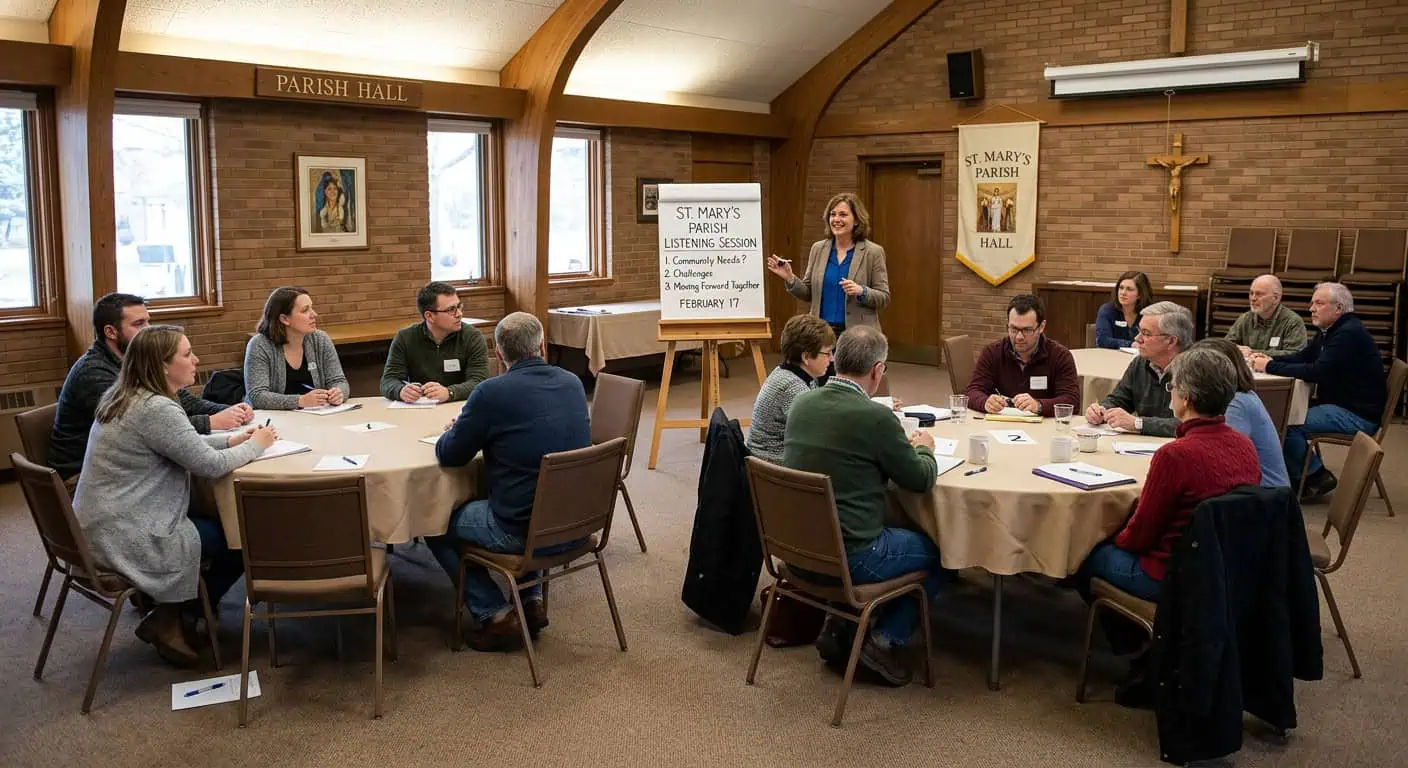
Opening a new school. Starting a parish. Relocating one. Consolidating programs across a region. Merging two communities into one.
These are decisions a diocese or a founding group cannot take back, and they are usually made on a mixture of demographic hope and the conviction of the people in the room. Both are normally sincere. Neither is evidence.
The ISPD General Feasibility Study answers the foundational question before the money question: is there enough real demand, real commitment, and real capacity here to sustain what you are considering — and if so, at what size, and in what location?
It ends with a recommendation, in writing: Go, No-Go, or Go with conditions.
This is not the study that sizes your campaign
ISPD runs two feasibility studies and they answer different questions. Communities conflate them constantly, and it costs them — they commission the wrong one and get a confident answer to a question they were not asking.
| General Feasibility Study | Financial Feasibility Study | |
|---|---|---|
| The question | Should this exist? | Can we fund it? |
| Asked when | A school, parish, site, or merger is being considered and does not yet exist in that form | The institution exists, and a capital project needs a number |
| Measures | Demographics, market demand, enrollment potential, location, community, and diocesan commitment | Donor capacity, leadership readiness, gift-range viability against a stated goal |
| Ends with | Go / No-Go / Go with conditions, plus a viable model, size, and location | A defensible campaign range, and a plan to build capacity if it falls short |
Run the financial study first, and you can raise a beautiful sum for a school the demographics will not fill. Sequence matters. See feasibility studies and capital campaigns →
When communities commission one
Five situations that share one feature: the decision is expensive, close to irreversible, and currently resting on conviction rather than evidence.
Opening a new school
A region with Catholic families and no Catholic secondary option. A grade school whose graduates scatter after eighth grade. A founding group with real conviction and a mailing list.
The study asks whether the demand is genuine and how large a school it would actually support — frequently smaller than the founding group hopes and larger than the diocese fears.
Establishing or relocating a parish
Growth moved. The building did not. A study evaluates where the households actually are now, where they are heading, and what a site change would do to participation, giving, and the school if there is one.
Consolidating or merging
The hardest work we do, and the most frequent request from dioceses. Which communities combine, on what timeline, at which site, and what is genuinely lost in each configuration.
Consolidation studies live or die on whether people believe the process was honest. That is why the interviews matter as much as the demographics.
Changing the model or the size
A classical or Chesterton-model conversion. A high school considering a smaller, more focused configuration. A school weighing whether to add or drop a division.
The question is never whether the model is good. It is whether this community will enroll in it and pay for it.
Diocesan planning across a region
A superintendent or bishop deciding where Catholic education should exist in ten years — which sites to invest in, which to sustain, and which decision cannot be deferred another year.
What the study measures
Go. No-Go. Go with conditions.
Every General Feasibility Study ends in one of three recommendations, stated plainly and defended with the data behind it.
Go. The demand, the commitment, and the capacity are there. The report names the model, the enrollment target, the location, the financial requirements, and the path to implementation — so the next meeting is about execution rather than whether.
No-Go. They are not there, and we say so. This is the recommendation nobody commissions a study hoping to receive, and it is the one that saves the most money. A Catholic school that opens on optimism and closes in year four does more damage to a community’s confidence than the school that was never opened.
Go with conditions. The most common outcome, and usually the most useful. Yes — at a smaller size than proposed. Yes — at the second site rather than the first. Yes — if the diocese commits formally, if a founding gift threshold is met by a named date, if intent-to-enroll converts at a stated rate. The conditions are specific and testable, which means you can go and meet them.
All three are real outcomes, not a disclaimer. We tell you the truth, even when it costs us — and on this service that sometimes means recommending against the project we were hired to evaluate, or recommending a smaller version of it than the people who called us wanted to hear.
What that looks like in practice: on the financial side, our study for St. Luke the Evangelist concluded the parish could raise $5.8–6.2 million against the $6.7 million the project required. We reported the gap rather than rounding it away. The parish proceeded with clear eyes and raised more than $7 million. An honest number a community can act on is worth more than a flattering one.
possible answers — all three are real
questions every study must settle
years serving Catholic communities, and nothing else
Catholic communities served
Questions leaders ask us first
What a diocese usually requires before a capital campaign is a financial feasibility study — can this community fund the goal. That study assumes the institution should exist and asks only what it can raise.
A General Feasibility Study asks the prior question. If you are opening, relocating, consolidating, or merging, the financial study cannot help you yet, because there is no established constituency to measure.
Typically four to six months, driven by how much primary research the question requires. A single-site relocation moves faster than a regional consolidation involving several parishes and their schools.
If a diocesan decision or a property deadline is setting the clock, tell us in the first conversation. We will say honestly whether the timeline permits a study worth trusting.
Most communities do, and that is fine — it is usually what prompted the call. What matters is whether you want it tested.
If the study is intended to produce a predetermined conclusion, we are the wrong firm and we would rather establish that now than four months in. A study everyone knows was steered persuades nobody, least of all the bishop or the donors you need it for.
Parents and prospective parents first, because theirs is the decision that determines everything else. Then pastors, principals, diocesan staff, current and prospective benefactors, civic and business leaders, and — in a consolidation — the people who stand to lose something.
That last group is not a courtesy. A consolidation study that has not heard the strongest objections has not found the real risks.
Yes, and it frequently does. A study commissioned about opening a high school sometimes concludes the region would better support strengthening the schools already there. A relocation study sometimes finds the site is not the problem.
The recommendation follows the evidence rather than the brief. That is the reason to commission one.
Yes. Founding groups, parish clusters, and diocesan offices all commission these, and a study carried out by an independent third party is often exactly what a founding group needs to be taken seriously.
Worth naming plainly: if the diocese will ultimately have to sponsor or approve what you are proposing, involve them in the study rather than presenting it to them afterward. Whether and under what conditions the diocese will participate is one of the five questions we settle.
Let’s Make Things Happen!
Tell us what you are considering and what decision is waiting on it. We will tell you whether a study can answer it in the time you have.
Contact us today to learn more.