
The Capital Campaign — Building the Future
There are moments in the life of a Catholic institution when the need is bigger than the operating budget can address.
A building that has served its purpose. A facility that no longer reflects the mission. An endowment that doesn’t yet exist. These aren’t annual expenses — they’re strategic investments in the long-term vitality of your community.
That’s what a Capital Campaign is for.
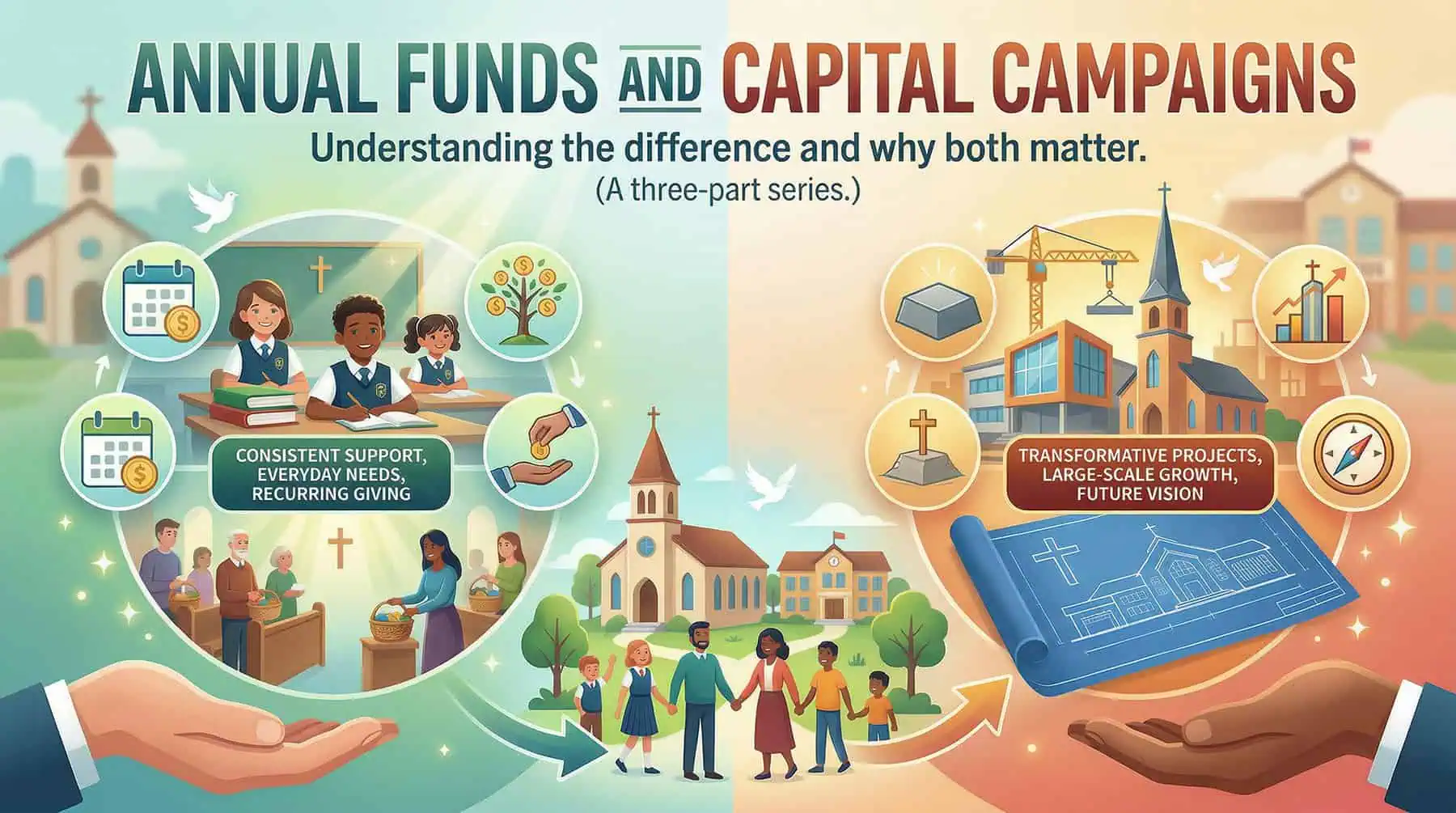
A Capital Campaign raises significant funds over a defined period — typically 12 to 16 months, with a multi-year pledge period — for transformational projects: new construction, major renovations, debt reduction, or endowment growth. These are not line items. They are commitments to the future.
What sets a campaign apart
A Capital Campaign is not a larger Annual Fund drive. It operates by different principles.
It is vision-driven. Donors aren’t asked to sustain what exists — they’re invited to invest in what’s coming. The case for a campaign has to be compelling enough that a donor sees themselves in the story of what’s being built.
It depends on financial leaders. Roughly 70% of campaign revenue typically comes from a relatively small number of leadership-level donors. That means identifying, cultivating, and personally engaging those prospects is essential — not optional.
It requires structure. Feasibility studies, a written case for support, prospect lists, solicitation strategies, and volunteer engagement aren’t bureaucratic overhead. They’re what separates a successful campaign from an exhausting one.
It is time-limited. The energy of a campaign is intentional and finite. That urgency is a feature, not a flaw.
One critical warning
A Capital Campaign should emerge from strength, not desperation.
If your Annual Fund is weak, your operating budget is strained, or your donor relationships are underdeveloped, a campaign won’t solve those problems — it will expose them. The strongest campaigns are built on a foundation of healthy operations, clear mission, and a community that already trusts its leadership.
The campaign builds the breakthrough. But the Annual Fund has to build the base first.