
How will we more meaningfully involve people in our mission and vision for the future in 2026?
At ISPD, we define development as “the meaningful involvement of people in your mission and vision for the future.” That definition becomes the true north on the development compass. Fundraising, enrollment, stewardship, events, and communication are all important—but they are tools, not the destination. The destination is an engaged community of disciples, invested in building the Kingdom of God through your Catholic school and/or parish.
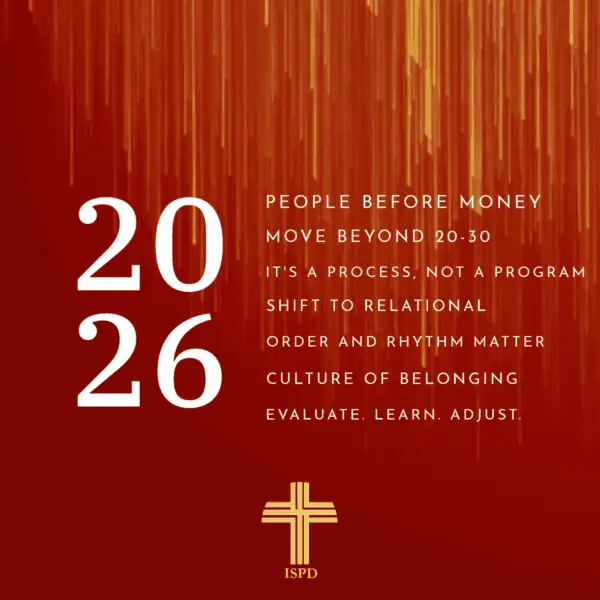
With that in mind, this month’s newsletter offers New Year’s Development Resolutions for 2026—practical, people-centered commitments that will help you set direction, gain traction, and sustain momentum throughout the year.
You certainly can’t adopt all of these at once. Our encouragement is to choose three to five resolutions, share them with your leadership team, and then build a simple Plan of Action for implementation over the next 12 months.
Resolution #1: Put People Before Money—Every Time.
When Catholic institutions struggle, the immediate instinct is often: “We need more money.” In reality, the #1 challenge is not raising money—it is engaging people.
In 2026, resolve to:
| Action | Description |
|---|---|
| Reframe conversations | With your board, finance council, and staff, talk about “meaningful involvement” before you talk about dollars. Connect every appeal to a story of mission and impact. |
| Expand your “people fuel” | Aim to invite 50–100 new people this year into meaningful roles: planning teams, committees, ambassadors, mentors, prayer partners, etc. |
| Track engagement, not just income | When you report on development, include: number of people involved, new volunteers, new donors, new families, and new prayer partners. |
Resolution #2: Move Beyond the Same 20–30 People.
Most Catholic schools and parishes have a faithful “first ripple” of 20–30 people who say yes to almost everything. Thank God for them—but your future growth depends on what you do with the second, third, and fourth ripples of your community.
In 2026, resolve to:
| Action | Description |
|---|---|
| Identify your “Ripples in the Pond” | List:
|
| Personally invite the outer ripples | Use face-to-face conversations, phone calls, and small-group coffees. Avoid relying only on e-mail and social media blasts. |
| Design multiple “entry points” | Create small, time-bound roles—one-time events, 1-hour listening sessions, short-term planning workshops—so new people can “try on” involvement without feeling overwhelmed. |
An important pattern we see in successful institutions: they consistently invite new voices to the table and practice the 60–40 rule—60% new people, 40% already involved—on planning teams and committees.
Resolution #3: Follow the 7 I’s: A Process, Not a Program.
Development is not a one-time campaign; it is a process. One of the clearest “compasses” you can use is the 7 I’s:
Identify → Inform → Invite → Involve → Implement → Invest → Improve
In 2026, resolve to:
| Step | Focus Action |
|---|---|
| Identify | Build or update your database so you know who your people are: parents, alumni, parishioners, grandparents, past parents, community partners. Fill in missing contact info. |
| Inform | Regularly share the “why” of your mission, your vision for the future, and concrete stories of impact. Move beyond announcements to formation. |
| Invite | Personally ask individuals to consider specific roles—“would you consider…” is one of the most powerful phrases in development. |
| Involve | Give them real work that matters: planning, hosting, mentoring, calling, welcoming. People stay where they feel useful. |
| Implement | Support volunteers and staff with clear plans, calendars, and accountability. |
| Invest | As relationships deepen, invite people to invest not only time and talent, but treasure—in carefully planned ways that honor both their faith and your mission. |
| Improve | Evaluate. Ask: What worked? What didn’t? What did we learn? Where do we need training or coaching? |
When you follow the 7 I’s, you shift from “event-driven” to relationship-driven development.
Resolution #4: Shift from Transactional to Relational.
One of the most common development mistakes (highlighted in our “40 Lessons Learned” book) is over-reliance on mass communication tools—direct mail, social media, and e-mail—as the primary way of inviting people to give and get involved.
These tools are helpful, but they are most effective when they support relationships, not replace them.
In 2026, resolve to:
| Action | Description |
|---|---|
| Set a person-to-person goal | Establish a simple target: “Each month, our pastor/principal/development leader will have at least 10–15 development-related conversations (visits, calls, coffees).” |
| Create small hospitality moments | Host small in-home gatherings, parent receptions for prospective families, ministry socials, or listening sessions. These can be powerful “on-ramps” for relationship-building. |
| Train your team in relational skills | Invest in simple, practical training on listening, storytelling, making the ask, and following up. Faculty, staff, and volunteers can all grow in these areas. |
Resolution #5: Commit to a Cadence—Order and Rhythm Matter.
Across our work with schools and parishes, one theme appears again and again: success follows a clear cadence. Random acts of development do not produce sustainable results.
In 2026, resolve to:
| Action | Description |
|---|---|
| Create a 12-month development calendar | Lay out your major activities month-by-month: communications, outreach, enrollment efforts, stewardship education, gratitude initiatives, events, and appeals. |
| Clarify who does what | Establish or strengthen your Development/Advancement Core Team. Define roles for the pastor/president/principal, development director, board, faculty, and volunteers. |
| Respect the logical order | For example: strengthen enrollment and annual fund before you launch a capital campaign; grow belonging and participation before you focus heavily on increasing gift size. |
A consistent cadence reduces stress, prevents burnout, and allows you to say “no” to good ideas that are out of order or off-timing for your community.
Resolution #6: Strengthen the Culture of Belonging.
People stay, give, and invite others when they feel they belong. The “lagniappe” of our work in enrollment management and development is always the same: healthy schools and parishes are marked by a visible culture of welcome, engagement, and shared mission.
In 2026, resolve to:
| Action | Description |
|---|---|
| Name what belonging looks like | Use some of the “active signs” we teach: win–win mindset, openness, transparency, seeking input, personal relationship-building, a quality-looking campus, and the “Three C’s” (Communication, Collaboration, Creativity). |
| Conduct simple listening opportunities | Schedule 2–4 listening sessions this year with different groups (parents, alumni, parishioners, faculty/staff). Ask: “What are our greatest strengths? Our biggest challenges? Your hopes for our future?” Capture and share results. |
| Respond visibly | When people share input, respond with clear action or explanation. Even small changes—improved signage, better welcome procedures, more transparent communication—signal that their voice matters. |
Belonging is not a slogan. It is an experienced reality created by consistent behaviors, structures, and communication.
Resolution #7: Evaluate, Learn, and Adjust.
In our strategic planning work, we often summarize the culture-shift process in six simple steps:
- Recognition of problem areas
- Assessment and identification of challenges through input
- Articulation and solving of challenges
- Prioritization of challenges and solutions into an Action Plan
- Implementation of Action Strategy Solutions
- Continued education
In 2026, resolve to:
| Action | Description |
|---|---|
| Build in evaluation moments | After each major effort (event, appeal, campaign, recruitment season), gather a small group and ask: What worked well? What needs improvement? What did we learn? |
| Use simple tools | Multi-voting, short surveys, quick debriefs, and written Plans of Action help you move from “good ideas” to organized, accountable follow-through. |
| Invest in your own learning | Development directors, pastors, principals, board members, and lay leaders all need time and space to grow. Make professional and spiritual development part of your annual plan and budget. |
Healthy development systems are learning systems. They do not repeat the same mistakes year after year; they adapt.
How to Start: A 90-Day Plan for Your 2026 Resolutions
To keep these resolutions from becoming just good intentions, consider this simple 90-day starter plan:
| Month | Foucs | 2-3 Concrete Steps |
|---|---|---|
| January | Clarify Direction |
|
| February | Build the Team |
|
| March | Engage People |
|
By 03/31/2026, you will have taken real, measurable steps toward orienting your development compass in the right direction.
A Final Word of Encouragement
Across the country, we continue to see Catholic schools and parishes that are growing, thriving, and transforming lives—not because they found a magic program, but because they embraced a people-centered process rooted in mission, vision, and faith.
As you step into 2026, remember:
- Development is ministry.
- People come before money.
- Belonging leads to believing.
- There is a cadence and order to this work.
- With prayer, planning, and perseverance, your community can do far more than simply “survive.”
If, as you consider your own New Year’s Development Resolutions, you sense that you need guidance in areas such as strategic planning, enrollment management, annual fund, capital campaign, or building a comprehensive development/advancement system, this is exactly the type of specialized expertise ISPD Consulting provides.
ISPD has over 36 years of experience helping Catholic institutions with these efforts and has successfully partnered with hundreds of schools and parishes nationwide. For professional guidance tailored to your specific situation, we recommend contacting ISPD directly at catholicdev@ispdconsulting.com. ISPD can provide customized solutions, proven processes, and hands-on support to help your Catholic school and/or parish achieve its goals in these areas.
Know of our prayers for you, your ministry, and the people you serve. May 2026 be a year in which your development compass points clearly—and consistently—toward building the Kingdom of God.